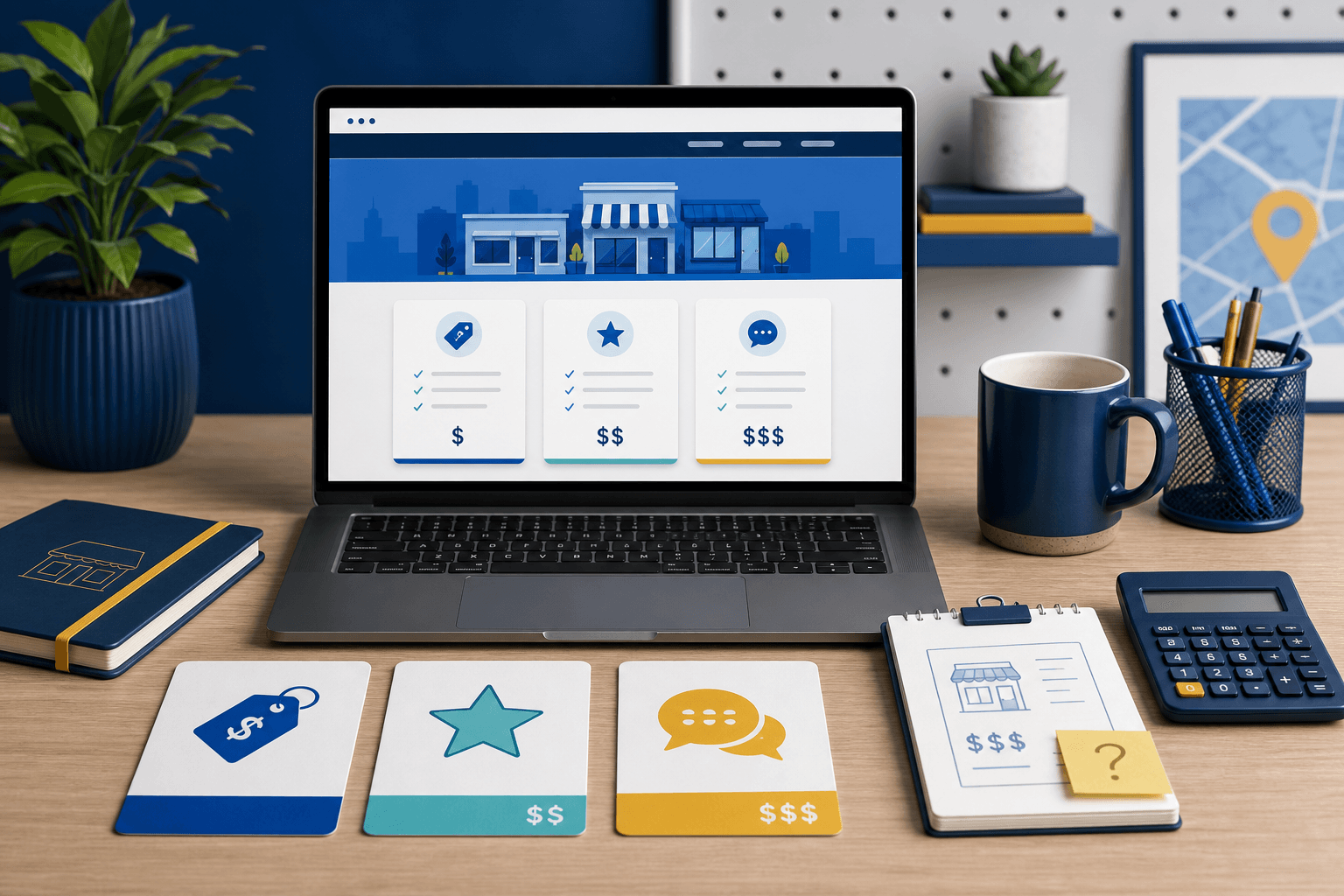
Price clarity helps buyers decide what to do next
Many small business owners hesitate before putting prices on a website.
That hesitation is understandable. Some work really does depend on the job. A contractor may need measurements. A consultant may need scope. A restaurant catering order may depend on headcount, delivery, setup, and timing. A custom software project may need discovery before anyone can price it responsibly.
But hiding every price can create a different problem. Serious buyers still need to know whether the business is roughly in range, what kind of commitment they are starting, and whether the next step is a quick purchase, a quote request, a booking, or a longer conversation.
Pricing on a small business website is not all-or-nothing.
The better question is: how much price clarity does the customer need before they can take the next useful step?
Show exact prices when the offer is repeatable
Exact prices work best when the business sells something with clear boundaries.
That might include:
- a fixed service package;
- a class, membership, or appointment type;
- a standard restaurant menu item;
- a product with known options;
- a simple pickup order;
- or a defined setup fee and monthly subscription.
If the customer knows what they are buying and the business knows what it will deliver, the website can usually show the price directly.
This is why a restaurant menu should not make customers guess. It is also why some service businesses can publish package prices for narrow offers, such as a consultation, inspection, starter plan, cleaning package, or standard tune-up.
Exact prices reduce friction because the buyer does not have to contact the business just to learn the basic range. They can decide faster and reach out with more confidence.
The danger is showing an exact price for work that is not actually exact. If the business frequently has to walk the price back after seeing the real situation, the website is creating false certainty. That hurts trust.
Use starting prices when the low end is clear but the final scope varies
Starting prices are useful when the business can honestly name the minimum commitment but cannot promise the final total before reviewing details.
For example:
- "Projects start at..."
- "Most first visits begin around..."
- "Packages start at..."
- "Catering minimums begin at..."
- "Custom builds are quoted after intake."
This gives the visitor a floor without pretending every job is the same.
Starting prices are especially helpful for services where the range is wide. They filter out people who are clearly not a fit, but they still leave room for the business to price the actual work.
The wording matters. A starting price should not be a lure that almost nobody qualifies for. If the final price usually lands far above the number shown, the page should explain what changes the scope:
- property size;
- number of locations;
- timeline;
- menu or product complexity;
- delivery area;
- integrations;
- custom design needs;
- or the amount of staff workflow behind the public site.
When the website explains why price varies, a quote request feels less mysterious.
Use ranges when customers mostly need budget context
A range can work when exact pricing would be misleading but silence would be worse.
Ranges are useful for buyers who are still deciding whether to reach out. They may not need a final number yet. They need to know whether they are looking at a $200 decision, a $2,000 decision, or a larger custom project.
A good range should be paired with practical context:
- what the low end usually includes;
- what pushes a project higher;
- what is not included;
- what information the business needs before quoting;
- and what happens after the visitor submits a request.
The goal is not to expose every detail of the pricing model. The goal is to help the customer self-select.
For many local businesses, a range can also make the sales conversation better. People who reach out already understand the rough size of the decision, so the first call can focus on fit instead of surprise.
Keep quote-first language when the job depends on real details
Some websites should not lead with a price table.
Quote-first language makes sense when the business needs details before it can responsibly price the work. That often applies to:
- repair and trade work that depends on site conditions;
- projects with materials, measurements, or permits;
- consulting work with different goals and stakeholders;
- restaurant catering or private events;
- custom software, mobile apps, dashboards, portals, or integrations;
- and any workflow where the price depends on what happens after the first customer action.
In those cases, the website can still be clear. It should explain why the quote is needed and what information the customer should send.
Weak quote-first copy says only "Contact us for pricing."
Stronger quote-first copy says something like:
"Tell us what you need, where the work is happening, and your timing. We will review the details and send the right next step instead of guessing from a generic package."
That kind of copy respects the customer. It says the business is not hiding the price for drama. It needs enough context to price the right job.
If the quote request itself is getting messy, the issue may be the form, not the pricing page. The article on when a contact form is not enough for a small business website explains when a basic form should become a smarter intake path.
Do not make price the only decision on the page
Price clarity helps, but it does not replace the rest of the website.
A visitor still needs to understand:
- what is included;
- who the service is for;
- what proof supports the claim;
- where the business works;
- how scheduling, quoting, ordering, or payment happens;
- and what they should do next.
This is especially important for local service businesses. A price without trust can still feel risky. A beautiful page without any pricing cue can still feel vague.
The best pricing sections usually sit near practical buyer information. A service page might show a starting price near what is included. A restaurant page might show menu prices near pickup or delivery details. A software page might explain that standard websites have simple pricing, while custom systems are scoped after intake.
That context turns price from a loose number into part of the buying path.
Watch for the moment pricing becomes a workflow problem
Pricing can reveal that the website is starting to become software.
If the price depends on a few simple details, a better intake form may be enough. If the price depends on repeated rules, approvals, customer accounts, subscriptions, delivery logic, staff routing, or order status, the business may need more than a static page.
That does not mean every business should jump into a large custom system. It means the owner should notice what keeps repeating.
For example:
- customers need to upload photos before a quote;
- staff need to approve a request before payment;
- customers need to choose pickup, delivery, or catering;
- a recurring service needs account management;
- or a custom project needs milestones, invoices, and status updates.
At that point, the website is no longer only explaining price. It is helping operate the price conversation.
That is the same line covered in how to tell when your website scope needs a custom quote. The more the website has to make decisions after the visitor acts, the more likely the project needs custom software, restaurant ordering, or a deeper workflow.
A simple decision framework
Use this sequence before rewriting the pricing section:
- If the offer is fixed, show the price.
- If the low end is clear but the final total varies, show a starting price.
- If buyers need budget context but the spread is wide, show a range with explanation.
- If the work cannot be priced without review, use quote-first copy that explains what details are needed.
- If pricing depends on repeated rules or handoffs, plan the workflow behind the page.
That framework keeps the website honest. It also helps the customer understand whether they should buy, book, request a quote, start an order, or talk through scope.
Where Blue Penguin fits
Blue Penguin's own website offer is intentionally clear: $200 to launch, $30/year after that, a three-month satisfaction guarantee, and no contracts. Blue Penguin handles design, development, hosting, domain setup, maintenance updates, and the everyday technical work around the site.
That pricing works because the standard website offer has clear boundaries. When the scope grows into custom software, mobile apps, restaurant ordering, payments, customer portals, or more complex workflows, pricing can still be negotiated around the real job instead of pretending every project is the same.
That is the practical lesson for any small business website. Show the price when the offer is defined. Explain the range when the work varies. Ask for a quote when the business needs real details. Then make the next step obvious.
If you want help deciding how your website should handle pricing, start with Blue Penguin's get started flow. If you are still deciding whether your site should take money directly, read when your small business website should take payments online.