The page count should follow the buying decision
A local business website can get thin in two different ways.
One version has only a homepage. Every service, location, proof point, and contact path gets squeezed into one long page. The business may look real, but the website gives searchers and customers very little room to understand a specific service.
The other version goes too far. Every tiny offer gets its own page, even when the business has nothing meaningful to say beyond the service name. The site starts to feel padded instead of useful.
The better question is not "How many pages should we have?"
The better question is: which services create a different buying decision?
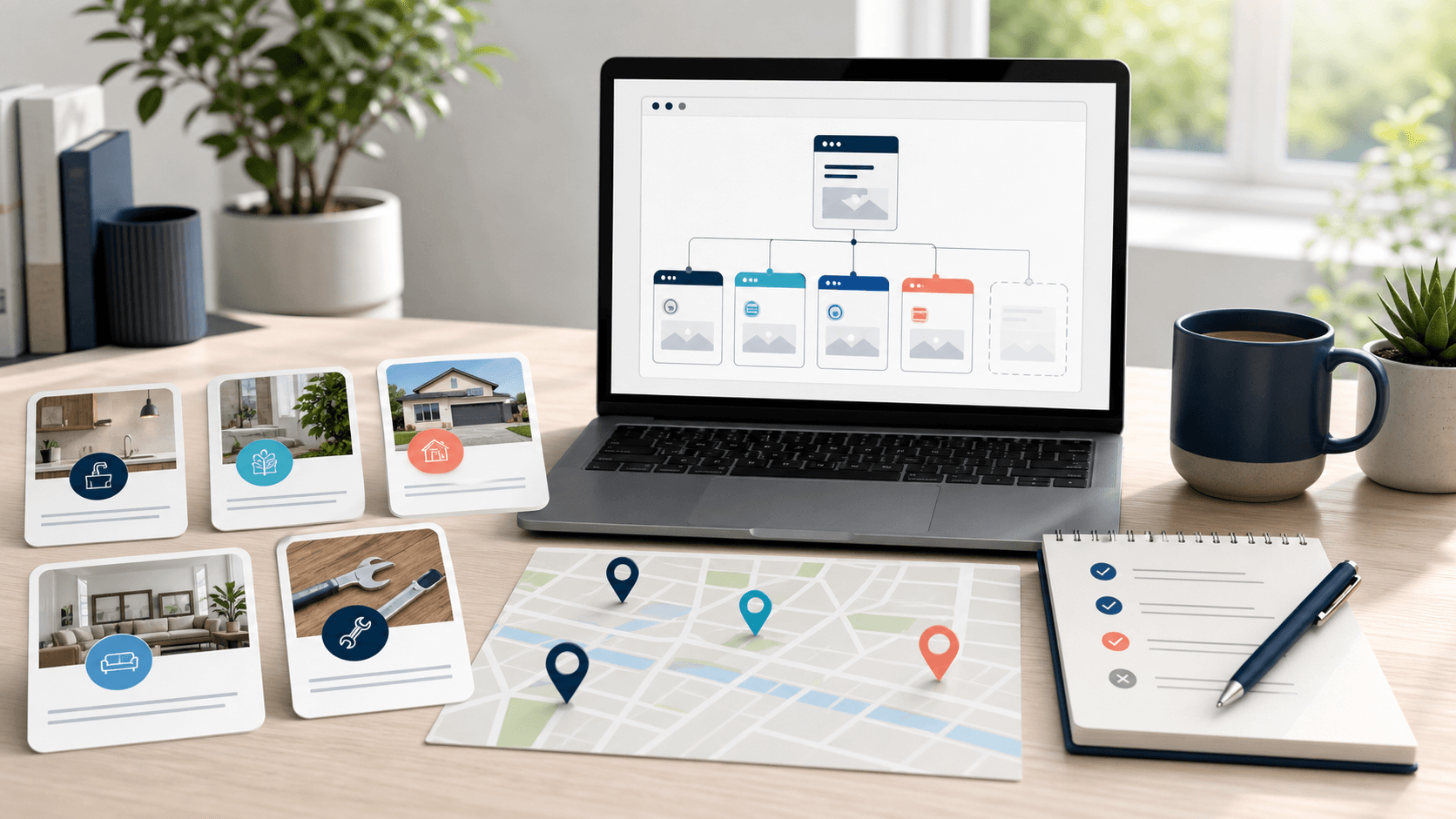
If a customer needs different proof, pricing context, photos, timing, FAQs, intake questions, or follow-up steps for a service, that service may deserve its own page. If several services share the same buyer, same proof, and same next step, they can often stay grouped together.
Give core revenue services their own room
Start with the services that matter most to the business.
That usually includes services that:
- bring in the most valuable leads;
- customers actively search for by name;
- need explanation before someone feels comfortable reaching out;
- have strong photos, examples, or proof;
- require a specific quote, booking, ordering, or intake path;
- or represent where the business wants to grow next.
Those services often deserve dedicated pages because they carry enough business weight to justify the space.
A plumber might separate water heater replacement, emergency plumbing, drain cleaning, and bathroom plumbing because each one has different urgency and questions. A salon might separate color, extensions, bridal styling, and treatments because customers compare those services differently. A restaurant might separate menu, catering, private events, and direct ordering because each one leads to a different action.
The goal is not to create pages for the sake of page count. The goal is to give important services enough room to convert.
Group small related services when the decision is the same
Not every service needs a standalone page.
Some services are real, but they do not create a separate decision. They may be add-ons, variations, seasonal options, or smaller tasks that customers usually buy as part of a larger service.
Those can often live inside a broader page.
For example, a landscaping company might not need separate pages for mulching, edging, spring cleanup, leaf removal, shrub trimming, and bed maintenance at launch. A strong "landscape maintenance" page may be clearer than six thin pages, especially if the same customer, quote process, and proof apply to all of them.
The same thinking applies to professional services. A consultant may not need a separate page for every workshop title if the buyer is really deciding whether to hire the consultant for team training. A broader page can explain the offer, then list the common formats inside it.
Grouped pages are not weaker when they are organized well. They are often stronger because they keep related services together and reduce clutter.
Split pages when the customer has different questions
A service deserves its own page when the visitor needs different information to move forward.
That difference might show up in practical questions:
- Is this urgent or planned?
- Is this residential, commercial, or both?
- Is the price fixed, estimated, quoted, or subscription-based?
- Does the customer need photos, measurements, dates, or menu choices ready?
- Does the work require an appointment, inspection, deposit, delivery area, or approval step?
- Does the business need to route this request to a different person?
If the answers change by service, the page probably should change too.
This is where service-page planning becomes more than SEO. The page structure should match the business workflow behind the site. If two services need different intake fields, follow-up messages, payment timing, or staff handling, separating them can make the website easier to use and easier to operate.
That is also where a basic website can start pointing toward custom software. If the business keeps repeating the same routing, quoting, status, or payment rules, the website may eventually need a dashboard, customer portal, mobile app, or internal workflow tool behind it.
Use search intent without stuffing keywords
Service pages help local SEO because they let the site answer specific searches.
But that does not mean every phrase becomes a page. A page should exist because it can help a real customer, not because a spreadsheet found a variation of a keyword.
A useful service page usually names:
- the service clearly;
- who it is for;
- the problems it solves;
- what is included or not included;
- where the business offers it;
- proof that the business can do the work;
- and the next step the customer should take.
That structure gives search engines and people the same signal: this page is about a real service, offered by a real business, with a clear path forward.
For a broader foundation, the article on what local SEO actually needs on a small business website covers the basics. Service pages are one part of that foundation, not a substitute for useful copy, fast mobile pages, clear contact actions, and honest local details.
Keep service areas separate from service decisions
Service pages and service-area pages answer different questions.
A service page answers, "Can this business solve my problem?"
A service-area page answers, "Does this business work where I am?"
Those questions can overlap, but they should not be confused. If the business serves several nearby towns in the same way, one strong service page plus one clear service-area page may be enough. If a specific service changes by location, then a more detailed structure may make sense later.
For example, a restaurant might offer pickup everywhere, delivery only within a specific radius, and catering in a wider area. A contractor might offer standard jobs across the region but emergency calls only in closer neighborhoods. In those cases, service and location details need to work together.
The article on planning service-area pages goes deeper on the location side. The short version is simple: create pages around real operational differences, not copy-and-paste geography.
Build the first version before chasing every variation
Most small businesses do not need a huge service-page map at launch.
A practical first version might include:
- A clear homepage that explains the business.
- Dedicated pages for the most important services.
- Grouped sections for smaller related services.
- A clear contact, quote, booking, ordering, or payment path.
- Internal links that connect related services and next steps.
That is enough to launch a useful site without burying the owner in page planning.
After launch, the business can expand based on real signals. If customers keep asking about one service, give it more space. If search traffic lands on a broad page but does not convert, sharpen the page. If the business wants more of a specific type of work, build a stronger dedicated page for that offer.
The website does not have to predict every future service on day one. It has to make the current business clear and leave room to grow.
Where Blue Penguin fits
Blue Penguin is useful when a local business wants service-page planning handled with the rest of the website instead of treated like a separate SEO chore.
The current offer is simple: $200 to launch, $30/year after that, a three-month satisfaction guarantee, and no contracts. Blue Penguin handles design, development, hosting, domain setup, maintenance updates, and the technical work around the site. Pricing can still be negotiated when the scope grows into deeper software, mobile apps, restaurant ordering, portals, payments, or more complex page architecture.
That matters because service-page decisions are rarely just writing decisions. They affect navigation, mobile layout, contact forms, quote paths, internal links, local SEO, and future software needs.
If you are not sure which services deserve their own page, start with Blue Penguin's get started flow. Bring your service list, the offers you want more of, and the questions customers ask before buying. From there, it is much easier to decide what needs a dedicated page and what should stay grouped for now.